 Skip to content

Traveling across Oregon reveals one of the most geographically diverse landscapes in North America. A short drive over the Cascade Range takes you from the lush, emerald forests of the Willamette Valley to the vast, sun-drenched high-desert plateau of Central Oregon. For a homeowner, this dramatic shift in geography is far more than a change in scenery; it represents an entirely different set of environmental challenges for your physical property. Your roof serves as the primary shield protecting your home, but the forces attempting to compromise that shield depend almost entirely on which side of the mountain range you live on.
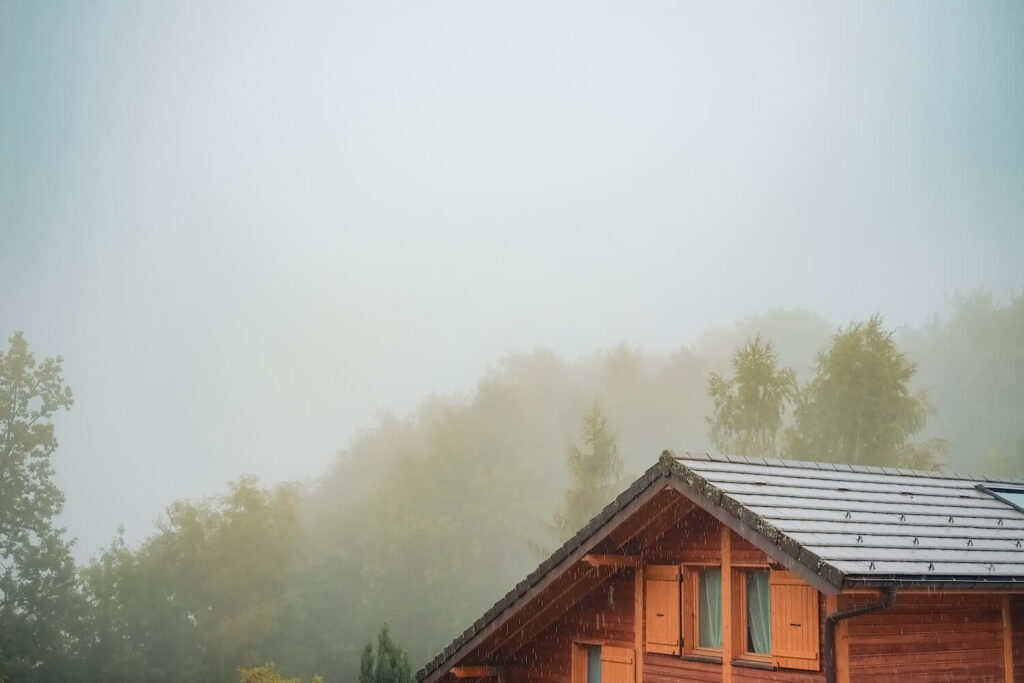
While a house in Eugene and a house in Bend might share similar architectural styles, their residential roofing systems exist in vastly different atmospheric environments. Eugene experiences continuous, soaking rainfall, high relative humidity, and dense tree canopies that slow down evaporation. Conversely, the high desert experiences lower annual precipitation but subjects rooftops to intense solar radiation, extreme daily temperature swings, heavy winter snow loads, and rapid freeze-thaw cycles. Moisture is the common thread that threatens roofs in both regions, but how that moisture manifests, whether as standing liquid, trapped humidity, expanding ice, or attic condensation, defines how you must care for your home. Understanding the distinct climate mechanics of Eugene and the High Desert is the key to executing a tailored roof maintenance strategy that maximizes your roof’s service life.
The Eugene Climate: Living in the Pacific Northwest Moisture Chamber
To understand roof degradation in the Willamette Valley, one must first appreciate the sheer volume and persistence of regional moisture. Eugene averages nearly 47 inches of rainfall per year, with the vast majority arriving during a long, damp wet season that stretches from October through April. Unlike short, intense tropical downpours that clear quickly, Oregon’s valley rain often arrives as a continuous, multi-day drizzle accompanied by low cloud cover and minimal wind.
This persistent ambient humidity creates a microclimate where building surfaces remain damp for weeks at a time. In heavily shaded neighborhoods surrounded by mature Douglas firs and bigleaf maples, roofs rarely get the direct sunlight necessary to dry out completely between storm fronts. This prolonged wetness creates the ideal breeding ground for biological growth, specifically moss, algae, and lichen.
The Biological Threat: How Moss Destroys Valley Roofs
Moss is not merely a cosmetic issue; it is a destructive physical force. Unlike simple surface algae, moss roots itself deeply into the porous granules of asphalt shingles. As the moss grows, it acts like a thick, water-logged sponge, holding moisture directly against the shingle surface day after day.
During heavy rainfall, this trapped water expands, forcing the lower edges of the shingles to lift upward. Once a shingle edge is raised, wind-driven rain can easily bypass the primary shingle layer and soak into the underlying wooden deck. Over time, this constant moisture saturation rots the wooden sheathing, rusts deck fasteners, and creates silent ceiling leaks that go unnoticed until interior drywall begins to stain.
Furthermore, falling leaves and pine needles naturally accumulate in roof valleys, the V-shaped channels where two sloping roof planes meet. When organic debris blocks these channels, rainwater backs up behind the dam, wicking horizontally underneath adjacent shingles. Ensuring that valleys, downspouts, and seamless aluminum gutters remain completely clear of debris is a constant, non-negotiable requirement for Willamette Valley homeowners.
The High-Desert Climate: Extreme Temperature Swings and Freeze-Thaw Shock
Crossing over the Cascades into Bend, Redmond, or Sisters reveals a completely different climate equation. The High Desert receives significantly less annual rainfall than the Valley, but it subjects roofing materials to severe thermal and physical stress.
During the summer, intense ultraviolet (UV) radiation bakes rooftops under clear, high-altitude skies. Dark asphalt shingles can easily reach surface temperatures exceeding 150°F on a hot afternoon. This relentless solar exposure triggers photo-oxidation, a chemical process that breaks down the essential petroleum oils that keep shingles flexible and water-resistant. Over time, UV degradation turns shingles brittle, causing them to dry out, lose their protective mineral granules, and crack.
Thermal Shock and Winter Ice Dynamics
The high desert is also famous for its rapid temperature fluctuations. A clear summer or autumn day might feature a afternoon temperature in the 80s followed by a brisk nighttime drop into the 30s. This rapid shifting, known as thermal cycling, causes roofing materials to expand and contract continuously.
This constant physical movement places immense stress on flashing transitions around chimneys, skylights, and plumbing vents. Over time, thermal movement pulls caulking away from metal joints, backs out mounting screws, and splits vulnerable neoprene pipe boots, creating microscopic gaps where water can enter.
Winter brings its own set of high-desert challenges in the form of snow accumulation and ice dams. When snow collects on a roof deck, interior building heat escaping through an uninsulated attic melts the bottom layer of snow. This melted water trickles down the roof slope until it reaches the cold, unheated eave overhang, where it freezes into a solid ridge of ice.
As melting water continues to flow down the slope, it hits this ice dam and gets trapped, forming a standing pool of water. Because flat water cannot drain off the sloped surface, it is forced backward underneath the shingle laps, soaking the roof deck and leaking into the home’s exterior walls.
Condensation, Dew Point, and the Internal Moisture Battle
While rainfall and snowmelt are obvious exterior threats, moisture also attacks roofing systems from the inside. Internal moisture dynamics, driven by relative humidity, condensation, and dew point, operate differently in Eugene than in the High Desert.
Condensation occurs when warm, moisture-laden air comes into contact with a surface that is at or below the dew point temperature, forcing the airborne water vapor to transform into liquid droplets.
- In Eugene: High ambient humidity means the dew point is frequently close to the air temperature. On cool, damp mornings, heavy condensation forms on “cool roof” surfaces like metal panels, asphalt shingles, and skylight glass. If the roof flashing or underlayment has micro-cracks, this morning dew can seep into vulnerable joints just as easily as rainfall.
- In the High Desert: The primary condensation threat occurs inside the attic space during freezing winter nights. Everyday household activities like cooking, taking showers, and running dishwashers generate warm, moist air that naturally rises toward the ceiling. If the attic floor lacks an airtight vapor barrier or adequate insulation, this warm moisture escapes into the cold attic space. When that warm air hits the freezing underside of the wooden roof deck, it instantly condenses into liquid water or frost. Over a long winter, this trapped internal moisture rots the wooden rafters, corrodes structural framing nails, and ruins attic insulation.
The Critical Role of Balanced Attic Ventilation
The universal defense against both interior condensation and summer heat buildup is a properly engineered attic ventilation system. A healthy roof requires a continuous, balanced draft of outdoor air flowing through the attic envelope.
Fresh, cool air enters through intake vents positioned along the lower soffit overhangs, travels upward along the underside of the roof deck, and exhausts out through continuous ridge vents or louvered static vents at the roof peak. Rafter baffles must be installed inside the attic to prevent loose-fill insulation from blocking these intake pathways.
In Eugene, proper ventilation flushes out trapped humidity before it can form mold on the roof deck. In the High Desert, proper ventilation keeps the roof deck cold during the winter, preventing the uneven snowmelt that causes ice dams, while purging extreme heat during summer heatwaves.
Comparing Material Performance Across Oregon’s Microclimates
Because environmental stressors vary dramatically between the Willamette Valley and the High Desert, selecting the right roofing material requires matching product characteristics to regional climate demands.
| Roofing Material | Eugene & Valley Climate Performance | High-Desert Climate Performance | Expected Lifespan |
|---|---|---|---|
| Architectural Asphalt Shingles | Very Good. Requires algae-resistant granule coatings to combat moss. | Excellent. Heavyweight dimensional profiles withstand 130 mph wind gusts and thermal shock. | 20–30 Years |
| Standing Seam Metal Roofing | Superior. Smooth surface sheds relentless rain and resists moss growth completely. | Superior. Handles heavy snow shedding, non-combustible fire resistance, and extreme UV. | 40–70 Years |
| Cement Roofing Tiles | Good. Provides excellent water shedding, but requires periodic sealing against moisture absorption. | Outstanding. Exceptional thermal insulation against heat/cold and high resistance to freeze-thaw cracking. | 50+ Years |
| Synthetic Cedar Shake | Excellent. Mimics rustic natural wood without absorbing moisture, rotting, or attracting moss. | Excellent. Highly stable under intense UV exposure and carries Class A fire resistance. | 40–50 Years |
Architectural Asphalt Shingles
Architectural asphalt shingles remain the most popular choice across the entire state due to their balance of affordability, style versatility, and proven durability. Modern architectural shingles feature multi-layered fiberglass mat construction that provides superior impact resistance, Class A fire ratings, and wind uplift resistance against sustained gusts up to 130 mph. For Valley homes, selecting shingles engineered with copper- or zinc-infused algae-fighting granules is essential to prevent dark streaks and moss colonization.
Standing Seam Metal Panels
For homeowners seeking maximum longevity, standing seam metal roofing represents the gold standard for both wet and high-desert environments. Constructed from thick 24-gauge or 26-gauge steel, standing seam systems feature concealed fasteners hidden beneath interlocked vertical ribs.
In Eugene, the smooth metal surface allows torrential rainfall to shed rapidly, leaving no texture for moss spores to grip. In the High Desert, metal panels reflect solar heat to reduce summer cooling bills, shed heavy snowpack effortlessly, and provide non-combustible protection against floating wildfire embers.
Cement Tiles and Synthetic Shakes
Cement tile roofing offers outstanding thermal insulation, dampening exterior noise while stabilizing indoor temperatures against extreme heat and freezing cold. Cement tiles are fire-, wind-, and hail-resistant, carrying a 50-plus year lifespan that increases a property’s resale appraisal value.
For homes in timbered settings where a traditional wood aesthetic is desired, synthetic cedar shakes provide the visual depth of natural wood without the high maintenance, moisture absorption, rot, or fire risks associated with real timber shakes.
The Maintenance Playbook: Location-Specific Care Protocols
Learn more on maintaining a roof in Oregon is not a passive endeavor; it requires an active, seasonal playbook tailored to your specific microclimate.
The Willamette Valley Maintenance Routine
- Schedule Semi-Annual Gutter and Valley Cleaning: Clear leaves, pine needles, and organic sludge from gutters, downspouts, and roof valleys every spring and late autumn. Ensure downspouts discharge water at least 5 to 10 feet away from the home’s foundation.
- Apply Safe Moss Treatments: Treat emerging moss in early autumn using safe, non-corrosive roof cleaning solutions. Never allow a contractor to use a high-pressure power washer on an asphalt shingle roof. High-pressure water blasts away the protective mineral granules, exposes the raw asphalt substrate, voids manufacturer warranties, and dramatically shortens the roof’s lifespan.
- Trim Tree Canopies: Prune overhanging tree branches back by 6 to 10 feet from the roofline. This allows direct sunlight and natural airflow to dry the shingles while preventing falling limbs from damaging the roof during winter windstorms.
The High-Desert Maintenance Routine
- Inspect Flashing and Sealants: Inspect metal flashing around chimneys, dormers, and skylights every autumn. Extreme thermal expansion can dry out and crack caulking, requiring fresh high-grade elastomeric sealant before winter snows arrive.
- Verify Ice Barrier Protection: Ensure that self-adhering ice and water shield membrane is installed along all eaves, valleys, and penetrations to prevent water intrusion from winter ice dams.
- Perform Safe Snow and Ice Removal: Following heavy winter snowstorms, monitor snow accumulation on low-slope sections and roof overhangs. If heavy ice dams form, hire licensed professionals who utilize specialized steam equipment to melt the ice safely without puncturing the underlying shingles.
Partnering with Oregon’s Certified Roofing Leader
Protecting your home against the contrasting weather forces of Oregon requires a roofing partner with deep regional expertise, factory certifications, and a commitment to uncompromising craftsmanship.
Deschutes Roofing stands as a premier family- and veteran-owned contractor dedicated to serving homeowners across the entire state. Operating from central offices in Bend and satellite locations in Eugene, Beaverton, Lake Oswego, and Portland, their factory-certified teams understand the precise engineering required to protect homes in both damp valley climates and high-desert mountain environments.
When you partner with Deschutes Roofing, every project begins with a comprehensive, top-to-bottom evaluation of your entire roofing envelope, including the wooden deck condition, seam flashings, gutter performance, attic insulation, and ventilation airflow. Their status as a GAF Master Elite® Contractor, Owens Corning Preferred Contractor, and Malarkey Emerald Premium Contractor places them in the top tier of roofing professionals nationwide. This certified status allows them to back their installations with non-prorated product warranties lasting up to 50 years, paired with an industry-leading 25-to-30-year workmanship warranty.
Frequently Asked Questions (FAQ)
Why does moss grow so quickly on roofs in Eugene and the Willamette Valley?
Eugene’s combination of high annual rainfall (nearly 47 inches), persistent humidity, and heavy tree shade creates a damp microclimate where moss thrives. Moss roots into porous asphalt shingles and acts like a sponge, holding water against the surface and lifting shingle edges.
Is it safe to pressure wash moss off an asphalt shingle roof?
No, power washing asphalt shingles is extremely destructive. The high-pressure water blasts away the mineral granules that shield the asphalt from UV light, reducing the roof’s lifespan and voiding manufacturer warranties. Homeowners should always use low-pressure “soft washing” paired with safe, biodegradable moss treatments.
What causes ice dams on High-Desert roofs in winter?
Ice dams form when trapped indoor heat escapes into an uninsulated attic, melting the bottom layer of snow on the roof deck. The melted water trickles down to the cold eave overhang and freezes into a ridge of ice, trapping subsequent snowmelt and forcing water backward underneath the shingles.
How does thermal shock affect roofing materials in Central Oregon?
Thermal shock occurs when intense summer sun heats roof surfaces past 150°F, followed by rapid cooling at night. This continuous expansion and contraction dries out asphalt oils, cracks neoprene pipe boots, and pulls sealant away from metal flashing joints, creating micro-gaps for water intrusion.
Which roofing material is best for both wet Valley weather and High-Desert cold?
Standing seam metal roofing is considered the top performer across all Oregon microclimates. Its smooth surface sheds rain and resists moss in Eugene, while its non-combustible rating, snow-shedding ability, and high thermal reflectivity excel in the High Desert.
How often should I have my roof professionally inspected in Oregon?
It is recommended to schedule a professional roof inspection at least once every two to three years, as well as immediately following severe wind, hail, or winter snowstorms. Early inspection catches minor flashing or sealant failures before they cause extensive interior water damage.
Conclusion: Climate-Engineered Protection for Your Home
Oregon’s natural beauty lies in its remarkable geographical diversity, but that same climate variation demands a thoughtful, location-specific approach to property maintenance. A roof maintenance strategy that works for a rain-soaked home in the Willamette Valley will not protect a high-desert property facing severe thermal swings, heavy snowpack, and ice dams.
By understanding the distinct moisture dynamics of your region, maintaining clear drainage pathways, ensuring balanced attic ventilation, and addressing minor material wear before seasonal storms arrive, you safeguard your home’s structural integrity and protect your family’s comfort.
When you are ready to evaluate, repair, or upgrade your roof, trust the factory-certified experts at Deschutes Roofing to deliver results tailored specifically to your home’s environment. Contact Deschutes Roofing today to schedule your comprehensive on-site inspection, explore your material and financing options, and secure a dry, beautiful sanctuary for decades to come.