 Skip to content

Imagine standing on the polished floor of a bustling commercial facility, a manufacturing plant, a retail warehouse, a medical office, or a modern distribution center. On the surface, daily operations run like clockwork. Forklifts hum down wide aisles, employees work at orderly workstations, and customers browse lit displays. Then, during a steady afternoon rainstorm, a single drop of water falls onto a desk. Above, a faint, yellowish-brown circle has bloomed across an acoustic ceiling tile.
To a busy facility manager or property owner, that solitary ceiling drip looks like the beginning of a minor maintenance hassle. You place a plastic bucket on the floor, wipe down the affected desk, and make a mental note to call a contractor once the weather clears.
However, in the physical reality of commercial building science, that ceiling stain is not the beginning of a problem. It is the final stage of a long, silent disaster that has been unfolding beneath your building’s exterior membrane for weeks, months, or even years.
Commercial flat and low-slope roofs are multi-layered, highly engineered envelopes designed to keep water completely separated from the building’s interior. When water breaches the outermost waterproofing layer, it does not immediately drop straight down into your workspace. Instead, it enters a hidden, dark ecosystem between the top membrane and your interior ceiling. Understanding what happens in those concealed spaces is essential for protecting your property value, avoiding catastrophic business disruptions, and preventing five-figure structural repairs.
The Architecture of a Commercial Roof Envelope
To understand where water goes after it pierces the outer barrier, one must first appreciate how a commercial flat roof is constructed. Unlike a residential home with steep slopes that use gravity to shed water quickly over shingles, a commercial roof is a dense sandwich of specialized industrial components laid over a low-slope deck.
Working from the top roof layer downward, a standard commercial roof assembly consists of:
- The Waterproofing Membrane: The visible outer shield, typically constructed from single-ply flexible membranes like Thermoplastic Polyolefin (TPO), Polyvinyl Chloride (PVC), or Ethylene Propylene Diene Monomer (EPDM) rubber, or multi-ply systems like Built-Up Roofing (BUR) and modified bitumen.
- The Cover Board: A dense, high-impact substrate board (often gypsum or high-density polyisocyanurate) that protects the insulation beneath from foot traffic, hail, and mechanical punctures.
- Thermal Insulation Layers: Thick slabs of rigid insulation, most commonly polyisocyanurate (Polyiso), expanded polystyrene (EPS), or mineral wool, staggered in layers to eliminate thermal gaps and maintain energy efficiency.
- Vapor Retarder: A continuous membrane designed to prevent warm, humid indoor air from migrating upward into the cold insulation stack.
- Structural Roof Decking: The foundational platform that spans the building’s steel trusses or concrete beams, constructed from corrugated steel panels, poured-in-place concrete, or heavy structural wood sheathing.
When a breach occurs in the outer membrane, whether from a split seam, a mechanical puncture caused by HVAC technicians, degraded flashing around a pipe boot, or standing ponding water, water enters this multi-layer assembly. What happens next is a progressive, three-stage cascade of degradation.
Stage 1: The Sponge Effect and Invisible Energy Drain
When water breaches the top membrane, its first stop is the rigid insulation layer. Because insulation boards are porous, they absorb and hold liquid like a massive, high-density sponge.
Rather than running straight to an interior drain or dripping into the building below, water spreads horizontally through the insulation stack. Capillary action drives moisture laterally across the roof deck, saturating neighboring insulation boards dozens of feet away from the original entry point. During this initial stage, you will see zero evidence of a leak inside your building. Your ceilings remain dry, your light fixtures operate normally, and your floor space remains clean.
However, the damage is already taking a heavy toll on your building’s operational efficiency. The primary function of rigid roof insulation is to provide thermal resistance (R-value). When polyisocyanurate or EPS insulation absorbs moisture, its insulating properties collapse. Water conducts thermal energy roughly 25 times faster than trapped air. As a result, saturated insulation creates massive “thermal bridges” across your roof deck.
During hot summer months, heat bakes through the wet insulation and pours into your facility, forcing your commercial HVAC units to run continuously to maintain setpoint temperatures. In winter, interior heat escapes rapidly through the damp roof, causing your heating bills to skyrocket. Long before you ever spot a ceiling stain, a saturated commercial roof quietly drains thousands of dollars from your operating budget in wasted energy costs.
Stage 2: Structural Deck Corrosion and Structural Decay
Once the insulation layer reaches its physical saturation threshold, liquid water can no longer be held in place. Gravity begins pulling the trapped moisture downward toward the structural roof deck. This is where the damage escalates from an energy penalty to a severe structural hazard.
The nature of the structural deck damage depends entirely on the building’s construction materials:
Corrugated Steel Decks
Steel decking is the most common foundation for modern commercial buildings. When water settles into the flutes of a steel deck, it initiates rapid oxidation and rust. Over time, trapped moisture strips away the steel’s protective zinc galvanized coating, eating through the metal framing. As the steel thins, the mechanical fasteners holding the insulation and membrane down lose their holding power. Under strong wind conditions, a roof deck weakened by rust is at a significantly higher risk of wind uplift and blow-off.
Concrete Decks
Poured concrete and pre-cast concrete planks absorb water readily. As trapped moisture sits on concrete, it leaches alkalis from the cement, leading to efflorescence and internal cracking. If the moisture reaches the embedded steel rebar, the metal oxidizes and expands, causing the surrounding concrete to spall and crack. In winter weather, freeze-thaw cycles cause trapped water inside the concrete deck to expand, fracturing the deck’s surface.
Wood and Plywood Decks
In commercial structures with heavy timber or plywood sheathing, persistent water intrusion causes rapid wood rot, delamination, and fungal decay. Rotted wood sheathing loses its load-bearing capacity, leading to visible sagging on the roof surface.
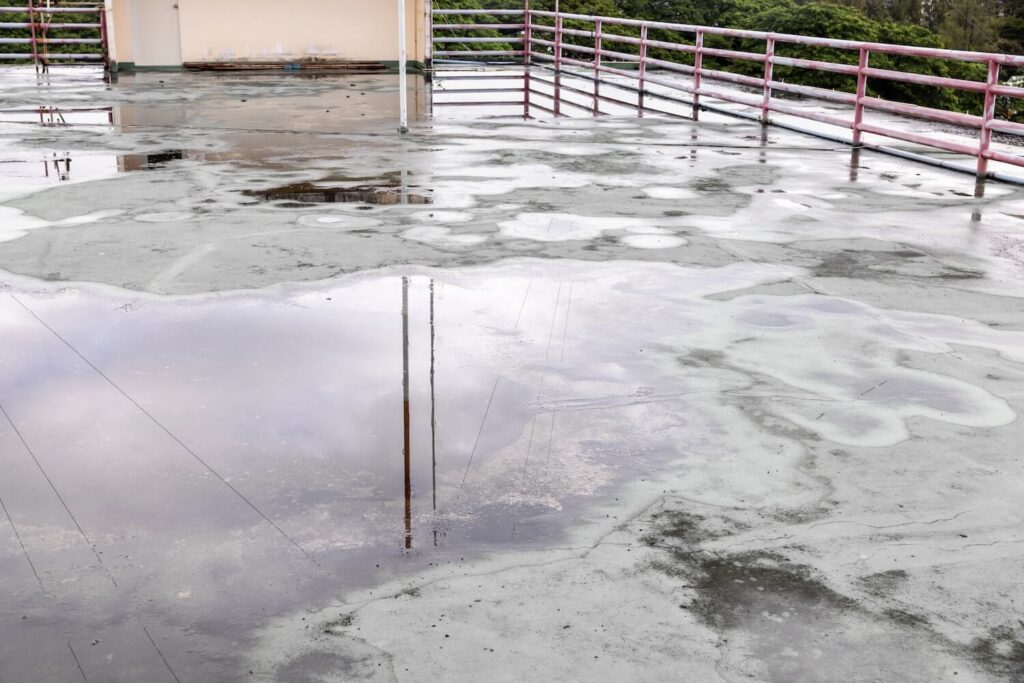
This sagging creates a dangerous compounding feedback loop. As the deck sags, it forms a low spot on the outer roof membrane. Rainwater naturally flows into this depression, creating an area of “ponding water”, standing liquid that remains on the roof surface for more than 48 hours after a storm. The tremendous weight of ponding water places even more physical stress on the weakened wooden deck below, drawing in more water and dramatically increasing the risk of a catastrophic roof collapse.
Stage 3: Biological Hazards, Electrical Shortage, and Interior Intrusion
Eventually, the volume of trapped water exceeds what the insulation, deck, and vapor barriers can hold. Liquid water finds a path of least resistance, typically through a seam in the steel deck, around an electrical conduit opening, or along an HVAC duct penetration, and trickles down into the interior space.
By the time water drips onto your floor or stains an acoustic ceiling tile, the environment underneath your membrane has been dark, damp, and warm for a extended period. This hidden space becomes a breeding ground for biological contaminants:
- Toxic Mold and Mildew: Mold spores require three things to flourish: organic food sources (paper facers on insulation boards or wooden decking), warm temperatures, and moisture. Trapped water underneath a commercial roof creates an ideal incubator. As mold colonies expand inside the roof assembly, fungal spores migrate into the facility’s return air plenums and HVAC ductwork, spreading throughout the entire building. This compromises indoor air quality (IAQ), exposes workers and tenants to respiratory health hazards, and creates serious legal liabilities under workplace safety regulations.
- Pest and Insect Infestations: Warm, standing water underneath a roof membrane attracts insects such as termites, carpenter ants, and mosquitoes, as well as rodents and birds searching for water sources. Pests can chew through wiring, damage vapor barriers, and introduce secondary sanitation risks into your facility.
- Electrical System Disruption: Commercial roof decks are crisscrossed with conduit lines powering overhead LED lighting, high-voltage HVAC compressors, and industrial machinery. When water seeps along these conduits, it can short out electrical panels, trip main breakers, destroy expensive control boards, and pose severe electrical shock or fire hazards for maintenance personnel.
The Financial Shock: Why Simple Patchwork Fails
When faced with an active ceiling leak, many property owners attempt to resolve the issue by hiring a quick handyman to apply a dollop of silicone sealant or roof tar around the nearest visible seam on the roof surface.
This approach almost always fails, leading to repeated service calls and wasted maintenance capital. The reason is simple: the location of an interior ceiling stain is rarely directly beneath the breach on the roof surface.
Water inside a roof envelope travels along structural steel flutes, slopes along vapor barriers, and flows along electrical conduits for dozens of feet before finding an opening to drip into the room below. Smearing sealant over a random seam near the stain does nothing to address the actual entry point, nor does it remove the gallons of trapped, destructive water sitting inside the saturated insulation boards beneath.
If wet insulation is left underneath a new patch, the moisture remains trapped indefinitely. It will continue to rot the structural deck, foster mold growth, and ruin energy performance. Eventually, when the true extent of the hidden damage is uncovered during a building sale or major storm, what could have been a localized restoration turns into a mandatory, complete tear-off and deck replacement costing tens or hundreds of dollars per square foot.
Proactive Commercial Asset Protection
Maintaining a commercial roof requires a proactive asset management strategy rather than a reactive emergency response. Establishing a structured preventative care protocol is the single most effective way to extend your roof’s service life and safeguard your business.
- Spring and Fall Inspections: Schedule formal semi-annual roof inspections to identify storm damage, cleared drainage pathways, and minor membrane wear before seasonal rain or snow loads arrive.
- Drainage System Management: Ensure that primary roof drains, scuppers, gutters, and overflow pipes remain completely free of leaves, dirt, and windblown debris to prevent standing ponding water.
- Controlled Access and Walkways: Establish designated, slip-resistant rubber walkways for HVAC technicians and service vendors to prevent accidental tool drops, foot-traffic punctures, and membrane scuffing.
- Fluid-Applied Coatings: For commercial roofs that are structurally sound with dry insulation but showing surface weathering, applying a liquid-applied silicone or acrylic roof coating can restore seamless waterproofing, reflect UV rays, and extend system lifespan by 10 to 20 years without business disruption.
Operating as a licensed, bonded, and insured contractor with offices across Oregon, Deschutes Roofing brings strict OSHA-compliant safety protocols, expert single-ply membrane installation, and custom commercial maintenance plans to businesses of all sizes. Their commercial teams specialize in flat roof repairs, complete replacements, fluid-applied coatings, and handling complex insurance claims to ensure property managers receive fair, comprehensive settlements.
Furthermore, Deschutes Roofing backs every project with long-term labor and product warranties, clear, transparent scope documentation, and flexible financing options to keep your facility fully protected without straining your capital budget.
Frequently Asked Questions (FAQ)
How does wet insulation under a flat commercial roof affect my building’s energy bills?
Wet roof insulation loses its thermal resistance (R-value) because water conducts heat roughly 25 times faster than trapped air. Saturated insulation creates massive “thermal bridges” across your building’s envelope, allowing outdoor heat to pour in during summer and indoor heat to escape during winter, forcing HVAC systems to work continuously and driving up energy costs.
What is ponding water on a commercial roof, and why is it dangerous?
Ponding water is standing liquid that remains on a flat roof surface for more than 48 hours after rainfall. Ponding water acts as a magnifying glass for UV rays, accelerating membrane degradation, and adds immense physical weight to the roof deck. Over time, this weight causes structural sagging, which holds even more water and increases the risk of deck failure or collapse.
How do professional commercial roofers find hidden leaks without tearing up the roof?
Commercial roofing experts utilize non-destructive diagnostic techniques, primarily infrared thermal imaging and electronic leak detection (ELD). Infrared cameras detect heat retention differences between wet and dry insulation after sunset, producing a visual map of trapped moisture beneath the membrane without damaging the roof surface.
What indoor safety liabilities are created by unaddressed commercial roof leaks?
Unaddressed roof leaks foster mold and fungal growth inside return air plenums, compromising indoor air quality and creating health risks for employees and tenants. Additionally, water dripping onto polished commercial floors creates severe slip-and-fall hazards, while moisture contacting electrical conduit runs can cause equipment shorts, power outages, and fire risks.
Conclusion: Take Control of Your Commercial Property
A commercial roof is the ultimate shield protecting your equipment, inventory, employees, and business continuity. Treating an interior water stain as a simple cosmetic inconvenience is a dangerous gamble that allows hidden moisture to ruin insulation, corrode structural decking, foster mold growth, and drive up energy costs.
By understanding what happens underneath your membrane after water breaches the surface, prioritizing early non-destructive diagnostics, and maintaining a proactive seasonal inspection protocol, you protect your capital investment and maintain complete control over your property’s future.
When you need an expert evaluation, long-term commercial roof repairs, or a complete roof system upgrade, trust the factory-certified commercial experts at Deschutes Roofing to deliver clear diagnostic proof, uncompromising safety, and lasting peace of mind. Contact Deschutes Roofing today to schedule your comprehensive commercial roof inspection, explore tailored maintenance plans, and keep your facility safe, dry, and profitable for decades to come.